Data-Driven Innovation programme publishes latest annual report

The University of Edinburgh and Heriot-Watt University’s Data-Driven Innovation (DDI) initiative has published its latest Annual Review, highlighting achievements from the academic year 2024-25.

Twelve case studies feature in the review, covering start-ups and spin-outs, research, and partnerships delivering positive impacts for a range of industry sectors.

2025 closed with the news that the DDI programme was named Collaborative Initiative of the Year by the Institute of Economic Development, with judges describing DDI as a flagship model of collaborative economic development, delivering innovation, skills, and infrastructure at scale.

The year also marked the conclusion of DDI's investment phase and completion of the final two Hubs. In April, Edinburgh Futures Institute (EFI) was officially opened by the University of Edinburgh Chancellor, HRH The Princess Royal, alongside Jenny Gilruth MSP, the Cabinet Secretary for Education and Skills, the Lord Provost of the City of Edinburgh and other city representatives.

The DDI Hubs continue to deliver significant economic benefit, with many examples noted throughout the report. By combining strengths across the University of Edinburgh, Heriot-Watt University and City Region Deal partners, the initiative is driving inward investment, including support to grow emerging companies.

Achievements against targets are:

Talent: The programme exceeded its course target by 15%, meaning that the full end-of-programme Talent target has been achieved. In 2024/25, DDI saw more than 37,000 completions – an 18% increase from 2023/24.

Research: DDI delivered £188 million in research activity – a 17% increase compared with 2023/24. The programme delivered £778 million worth of activity in total, which represents 79% of its total research target.

Adoption: The programme generated £20 million in income alone, representing 21% of total activity to date. DDI has exceeded its end-of-programme target by 79%.

Entrepreneurship: The initiative supported 90 early-stage data-centric companies, surpassing its unique company end-of-programme target by 53%. DDI has exceeded its follow-on funding target by nearly 1,000%, with DDI companies receiving £225 million funding in 2024/25 alone.

DDI's Senior Responsible Officer, Professor Kim Graham, said: "Delivery of these outcomes requires commitment, imagination and ambition. I am grateful to our DDI staff and students for their hard work and thank our industry, third sector and civic partners, as well as the Scottish and UK Governments, for helping make the Edinburgh & South East City Region DDI programme so successful. The City Region Deal is evidence that local innovation funding – focused on growing regional sectors through the application of emerging future technologies – delivers to modern industrial strategies, boosting economic productivity, entrepreneurship and jobs."

Read the full report here
Bush Loan Junction Upgrade Reaches Final Design Stage as Major City Deal Project Hits Halfway Mark

As one of the flagship infrastructure investments of the Edinburgh and South East Scotland City Region Deal, the Bush Loan junction upgrade has now moved into its final design phase. Midlothian Council has confirmed that engineers are preparing detailed designs following planning approval, with contractor appointment expected in mid‑2026 and construction scheduled to begin later this year.

Supporting economic growth

The Deal, launched in 2018 and now at the halfway point of its 15‑year programme, has already contributed £3.6 billion to regional economic growth. The Bush Loan improvement will support further expansion of the University of Edinburgh’s Easter Bush Campus near Penicuik, Midlothian, home to one of six Data‑Driven Innovation hubs funded through the City Region Deal. These hubs are accelerating innovation across key sectors, with the Easter Bush Agritech Hub advancing data‑driven research and industry collaboration to position the region as a global centre for agritech and veterinary excellence.

At the heart of AI

Easter Bush’s importance continues to grow. Last year, the UK Government confirmed up to £750 million in funding for the University of Edinburgh’s Advanced Computing Facility at Easter Bush, which will host the UK's next national supercomputer—placing the region at the heart of national efforts in AI and high‑performance computing.

Shaped by public feedback

The existing Bush Loan junction has longstanding safety and visibility issues, including the lack of a dedicated right‑turn lane from the A702. The approved scheme, shaped by public and stakeholder feedback, will replace the junction with a new roundabout designed to:

 Improve safety for vehicles joining and leaving Bush Loan

  • Reduce traffic speeds on the A702

  • Support safer, more reliable access to key employment and research sites

  • Enable future development across the Midlothian Science Zone by addressing Transport Scotland’s safety concerns

Work has progressed

Since planning consent was granted, early works have progressed, including archaeological assessments, ecology surveys and ongoing technical discussions with Transport Scotland. Ground investigations are being finalised, and consultants are bringing together the remaining information required for the final tender package.

Next steps

Once detailed design work concludes, next steps will include:

 Final agreement on land access

  • Competitive tendering of the works

  • Completion of contract documentation

  • Appointment of a contractor in summer 2026

  • Construction starting before the end of 2026

  • Targeted completion in 2027

Wider proposals

The Bush Loan upgrade is linked to the wider A701 Relief Road and A702 Spur Road proposals, which remain under consideration by the planning authority.

Local benefits

Midlothian Council’s Cabinet Member for Roads, Councillor Dianne Alexander, said the project will “deliver long‑term safety improvements, support local growth and strengthen connections between communities, education and employment.”

City region Deal joint support

The £1.3 billion City Region Deal is jointly supported by £300 million each from the Scottish and UK Governments, bringing together local authorities, universities and government to support economic growth, improve travel and widen opportunities across the region.

Healthy results for City Region Deal at halfway point

Almost 30,000 jobs have been created or supported since 2018 thanks to the Edinburgh and South East Scotland City Region Deal.

The Deal, which launched in 2018, is at the halfway point in its 15-year delivery timeline and has already contributed £3.6 billion in economic growth.

The £1.3 billion Edinburgh and South East Scotland City Region Deal is supported with £300 million each from the Scottish and UK governments.

Over 5000 businesses have engaged directly with the Deal through partnerships or collaborations on training and skills development, innovation, and jobs, and more than £1 billion in additional funding has been secured for Deal-related projects.

From Fife to the Scottish Borders, the Deal is delivering investment across housing, transport, innovation, culture, and skills and employment.

Highlights include seven new innovation hubs to increase links between university research and industry, housing developments that have so far delivered almost 8,500 new homes, and two industrial innovation zones.

Find out more about the benefits achieved through the City Region Deal on the Benefits Realisation Dashboard.

Councillor Jane Meagher, Chair, Edinburgh and South East Scotland City Region Deal Joint Committee, said:

The Edinburgh and South East Scotland City Region Deal is delivering real results. Now worth £1.7 billion, it generates the greatest additional investment of any Scottish city region or growth deal. The programme is driving economic growth, improving the services and functions the city relies on and creating sustainable communities, while ensuring benefits reach all of the region. To date, it has created over 29,000 jobs and built more than 8,000 homes and supported over £3.6 billion in Gross Value Added. The jobs created and skills improvements ensure that local people can access high-quality, better-paid work and benefit from the prosperity created by the City Region Deal.

Garry Clark, Chair of the Deal's Regional Enterprise Council, said:

Businesses across Edinburgh and South East Scotland will rightly judge the City Region Deal by the difference they can see on the ground. The Deal set ambitious targets from the outset, and it has consistently delivered measurable results.

In Fife, for example, small firms are benefiting from new industrial units that fill a vital gap in the local property market, and East Lothian’s new Innovation Hub is already home to a diverse group of businesses. Across the region, employers now have access to a stronger talent pipeline thanks to the award winning Integrated Regional Employability and Skills programme. The Deal is helping strengthen partnerships between industry, the third sector, and academia—collaboration that would be far harder to achieve in isolation. It has also helped build a resilient local supply chain, ensuring that local businesses and local skills have been central to the delivery of each project.

Together, these achievements show an impressive track record and signal even greater transformation ahead as the Deal continues to support the regional economy and the people who drive it.

Deputy First Minister Kate Forbes said:

Working together with local partners we have provided £300 million towards this Deal to drive economic opportunities and help communities across Edinburgh, the Lothians, Fife and the Borders to thrive.

From new jobs and skills training to investment in innovation and thousands of new homes this funding is delivering tangible benefits that people across the region can see and feel in their daily lives.

Whether it's a new concert hall for Edinburgh, delivering a national centre for robotics and AI at Heriot-Watt University or supporting Scotland's largest brownfield regeneration project at Granton Waterfront, these investments will shape this region for generations to come.

UK Government Scotland Office Minister Kirsty McNeill said:

We are backing Edinburgh and South East Scotland with £300 million UK Government funding. It’s great news that half has already been spent on transformational projects in areas such as innovation, skills and employment, helping to create or support tens of thousands of jobs and contributing billions of pounds of economic growth. We look forward to working with partners over the rest of the deal to maximise the benefits from the remaining funding to deliver economic and community renewal across Scotland.


Blindwells prospectus published – seeking Scottish and UK Government support & investment for future development

The Blindwells Development Area is the largest of seven strategic sites included in The Edinburgh and South East Scotland City Region Deal (ESES Deal) which have been identified as being able to deliver new housing at pace and scale in the areas where national need and demand is greatest.

 A new Blindwells Prospectus has now been published, setting out the potential benefits that the site could bring locally, regionally, nationally and to the UK as a whole. It highlights the importance of planned support and investment both now and in the years beyond the ESES Deal period. East Lothian Council, working with private sector partners, is seeking to unlock these strategic benefits through the development of a business case under the ESES Deal for Government consideration.

Blindwells New settlement prospectus - front cover

 Government and wider public and private sector support will be essential to realise the full potential of Blindwells as a well-planned, well-connected new settlement with economic opportunities as well as warm, energy efficient homes, including affordable homes, which can help to address inequality, child poverty and productivity across the region. Government approval of the associated business case stages is necessary to ensure that the potential expansion of Blindwells can be progressed in a properly planned, managed and funded way.

The Prospectus follows the decision taken in June 2025 by East Lothian Council and the ESES Deal Joint Committee to approve a Strategic Outline Business Case for Blindwells, for submission to the Scottish and UK Governments. Since then, both Governments have acknowledged the importance of the project to the ESES Deal programme, and the Scottish Government has identified it as a strategic ambition in its Housing Emergency Action Plan, published in September 2025.

The Prospectus is a public document compiled by the council and the ESES Deal with Blindwells landowners and developers that can be used to help engage stakeholders during the next steps of business case development – focusing on the importance of partnership working, an infrastructure-first approach and financial innovation in capital and revenue terms, with the need for an appropriate delivery vehicle to be established.

As a long-term project, over the next 30 years, Blindwells new settlement has the capacity to deliver over 10,000 new homes, of which at least 2,500 will be affordable homes, as well as a town centre with employment and wider commercial and other opportunities. It could increase East Lothian’s population by around 25% and become a new regional hub for service provision and business, commercial and leisure activity.

East Lothian Council Leader Norman Hampshire said: “East Lothian is one of Scotland’s smallest local authorities with one of the lowest levels of revenue support grant nationally, but we are also one of the fastest growing areas in Scotland. All of this means that to deliver the essential infrastructure required to enable Blindwells to reach its full potential as an influential, innovative, healthy and net zero place that will be of national importance, we must leverage our position as part of the Edinburgh and South East Scotland City Region Deal to gain the financial support that it can provide, plus attracting a large amount of private and public sector investment well into the future. The publication of this prospectus is an important step in this project and allows anyone with an interest to see at a glance the benefits it could deliver to our local communities and nationally.”

The next steps include the development of an Outline Business Case, which if approved by Government will be followed by Full Business Cases, which could ultimately lead to implementation subject to business case approvals and wider statutory processes.

Dunard Centre marks start of construction with groundbreaking ceremony

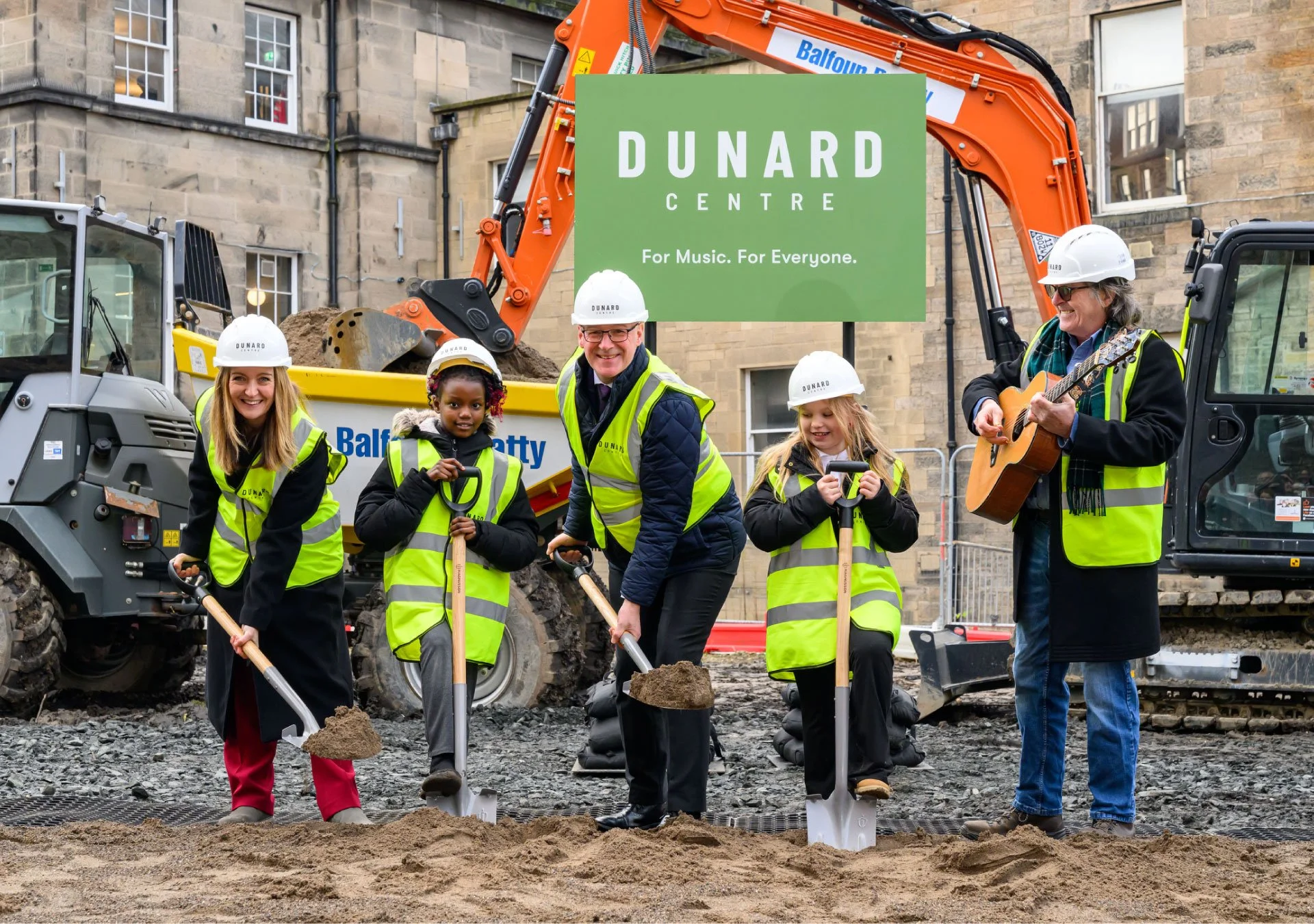
Guests including First Minister John Swinney, singer-songwriter Dougie MacLean and pupils from Broughton Primary School gathered on site for a morning of music, speeches and celebration

Yesterday, ground was officially broken on the Dunard Centre, marking the start of a four-year build with a ceremony that celebrated this historic moment before construction begins later today.

Scotland’s First Minister John Swinney joined representatives of the UK Government, City of Edinburgh Council, David Chipperfield Architects, Balfour Beatty and NatWest Group on site, with guests enjoying a range of musical performances that showcased the breadth and calibre of talent the venue will bring to Edinburgh.

This included singer-songwriter Dougie MacLean delivering an emotive rendition of his iconic ‘Caledonia’ in collaboration with P6 pupils from nearby Broughton Primary School,  pipes from Finlay MacDonald, Director at The National Piping Centre, and a string quartet from the Scottish Chamber Orchestra starting the morning with a short performance. 

Kickstarting a series of speeches from stakeholders and partners, Dunard Centre chief executive Jo Buckley thanked politicians and other guests for attending the ceremony, speaking about her personal focus on ensuring the venue plays a key role in enriching the lives of people across the city.

She said: “Today’s performances offered a glimpse of the breadth and calibre of talent the Dunard Centre will bring to Edinburgh.

“It is hard to build a concert hall — but important things are never easy. And what we are building here is not just a concert hall. It is a commitment to people and to community and to the transformational power of culture, which we believe really does change lives.”

“This venue will truly be a ‘Hall for All’, creating an open, accessible, and welcoming space in the heart of the city. It will be a place where Scotland’s musical legends will inspire the next generation of artists, giving children their first encounter with a concert hall and allowing them to feel the electricity that comes from live performance.

“I want to thank everyone who attended today for being part of this important moment for the project, and for their continued support. Reaching this key milestone has been made possible thanks to a unique partnership between government and private philanthropy, the product of which will be a world-class venue that Scotland can be proud of.”

Speaking at the groundbreaking, First Minister John Swinney said: “It’s a privilege to break ground and mark the start of construction of the Dunard Centre. The ‘Hall for All’ is a prime example of public and private investors coming together to invest in exciting, innovative projects that will help to grow our economy and significantly enhance Scotland’s cultural offering.  

“Jo Buckley was part of the Scottish delegation to attend Tartan Week in New York with me earlier this year and spoke at the iconic Carnegie Hall. Partnerships were fostered and strengthened by this visit and it’s been a pleasure to once again address an audience of Scotland’s leading cultural and arts stakeholders as we prepare to start building this exciting new venue.”

UK Government Scotland Office Minister Kirsty McNeill attended on behalf of the UK Government. She said: “The Dunard Centre will be a tremendous addition to Edinburgh’s cultural landscape and I welcome construction getting underway. The UK Government is a big supporter of the project, investing £10 million as part of our £300 million commitment to the Edinburgh and South East Scotland City Region Deal. 

“We look forward to continued close working with the ‘Hall for All’ partners so that local communities and visitors from around the world can enjoy such a world class facility as soon as possible. The UK Government is investing more than £2 billion in dozens of important local and regional projects the length and breadth of Scotland over 10 years, bringing much-needed economic and community renewal.”

Designed by David Chipperfield Architects with Reiach and Hall Architects, the Dunard Centre will be the UK’s first Nagata Acoustics hall, bringing together exceptional architecture, extraordinary acoustics and bold, ambitious programming to rival the best in the world in audience experience.

The Dunard Centre will be the first concert hall designed by Sir David Chipperfield. Speaking at the ceremony, the renowned architect said: “We are deeply honoured to have been selected to design this new cultural building in the historic heart of Edinburgh. We look forward to the concert hall becoming a significant contribution to Edinburgh’s cultural life and finding its place in the city’s extraordinary architectural and urban heritage”.

NatWest Chief Executive Paul Thwaite spoke about the bank’s support of the project, saying: “At the Royal Bank of Scotland, we are proud to partner in building a world-class facility here in the heart of Edinburgh. Seeing the Dunard Centre move from vision to reality is a testament to what ambition and collaboration can achieve. This world-class concert hall will be a huge asset to Edinburgh’s cultural life that will attract audiences from across the UK and further afield. We look forward to continuing to support this landmark project.”  

The construction of the new concert hall is being led by Balfour Beatty. Nick Crossfield, Divisional CEO of Balfour Beatty’s UK Construction Services business, said: “Breaking ground at the Dunard Centre is a landmark moment, taking us one step closer to realising Edinburgh’s first purpose-built concert hall in a century.

“We now look forward to working in close partnership with IMPACT Scotland and applying the highest standards of modern construction throughout, to realise this visionary design that will stand as a beacon for music and culture for generations to come.”

A combination of private and public funding has secured this world-class venue for Scotland and the UK. The Dunard Centre is part of the Edinburgh and South East Scotland City Region Deal, through which the Scottish and UK Governments committed £10 million each, alongside £5 million from the City of Edinburgh Council. Last month, First Minister John Swinney made an in-principle pledge of an additional £20 million in funding, which has been matched pound-for-pound by Dr Carol Colburn Grigor. Alongside the public funding, IMPACT Scotland has raised over £100 million to date from private philanthropy, setting a new capital funding record for a cultural project in Scotland.